Hi Everybody,
As we near the end of the third quarter, we're going to take a step back and take a look at some human rights issues we've discussed while reading Trash.
Today we are going to have an in-class activity which will let us voice some of the opinions that I know all of you have. As we've read this book, we've encountered and discussed a variety of humanitarian disasters that are taking place all around the world: Corrupt law enforcement, child imprisonment, dumpsite children, shattered family structures, etc. During each discussion, it was easy to see that you all feel very strongly about each of these issues.
So in class we are going to each consider one of these issues by writing beliefs up on posters labeled:
Corrupt Law Enforcement
Child Imprisonment
Dumpsite Children/Shattered Families
We are then going to write a personal belief statement which explains how we feel about one of these issues. After this part of the activity, we will visit a separate poster labeled, Why? where we will consider the reasons these things are happening. After we've had a discussion about the many different elements that build up to these situations, we will revisit our statement. Has it changed since you've considered some of the reasons we've come up with?
-Mr. Thomas
Hello everyone! This is an area online where you can access links to my favorite sites, work to complete some of your in-class assignments, and find out what you missed if you were absent.
Showing posts with label Mr. Thomas. Show all posts
Shakespeare Scavenger Hunt Quiz
Hi, class!
Below you will find all of the categories for the Shakespeare research webquest that we've been assembling for the last few class periods. They are listed in the same order as on the last blog post, only now, each topic is hyperlinked to one of your classmate's blogs! You're going to have to search through the facts that they have in their posts in order to answer the questions they've come up with.
All of the questions are in quiz form, conveniently in one word document which Mrs. DeRaps has sent to you via Email. Look through the list of questions and start searching these blogs for the answers.
All you need to do is copy and paste those answers into the word document.
Yes, this quiz will be graded, so you will need to work individually and quietly until you are all finished. Happy hunting!
Shakespeare's Biography
Shakespeare's Biography (2)
Queen Elizabeth I and the Elizabethan Period
Renaissance Italy
The Plague
Elizabethan Sports
The Globe Theater
The Globe Theater (2)
Elizabethan Women/Hairstyles
Fashion/Color of Clothing
Food
Torture and Punishment
Marriage
Love
When you're all done, print your completed word doc or email it to me and check in with me.
-Mr. Thomas
![]() |
| aw yeah |
All of the questions are in quiz form, conveniently in one word document which Mrs. DeRaps has sent to you via Email. Look through the list of questions and start searching these blogs for the answers.
All you need to do is copy and paste those answers into the word document.
Yes, this quiz will be graded, so you will need to work individually and quietly until you are all finished. Happy hunting!
Shakespeare's Biography
Shakespeare's Biography (2)
Queen Elizabeth I and the Elizabethan Period
Renaissance Italy
The Plague
Elizabethan Sports
The Globe Theater
The Globe Theater (2)
Elizabethan Women/Hairstyles
Fashion/Color of Clothing
Food
Torture and Punishment
Marriage
Love
When you're all done, print your completed word doc or email it to me and check in with me.
-Mr. Thomas
Poetry Friday: Incident On the Road To the Capital
Today we are going to get started on a Poetry Friday assignment. I am borrowing this assignment from Mrs. DeRaps from a previous post, so if you would like to see the original for comparison purposes, feel free to visit the link!
We are going to read and take a good look at Dara Wier's unique poem Incident On the Road To the Capital. What do you notice about this poem that is much different from the others we've read in this class? This happens to be a "prose poem," a type of prose characterized by having poetic imagery and concentrated lines. The lines sound more like sentences, and we get a much clearer sense of story in this poem than we usually do. Though, in this poem, a lot of the guesswork has been taken out of deciphering the action, there's still much more to examine in this peculiar scene Wier has crafted.
The Poetry Friday assignment will be to adapt this poem to fit the plight of a tribute in The Hunger Games. It can be any of our main characters, but it can also involve tributes from other districts. Study the poem line by line and tell the story of the tribute, explaining his or her story. If you decide to write about another district, use your map of Panem to include some details about that district in your poem.
I will re-visit this post after we've finished this assignment and update with the approach we decide to take. Until then, have fun with this!
-Mr. Thomas
We are going to read and take a good look at Dara Wier's unique poem Incident On the Road To the Capital. What do you notice about this poem that is much different from the others we've read in this class? This happens to be a "prose poem," a type of prose characterized by having poetic imagery and concentrated lines. The lines sound more like sentences, and we get a much clearer sense of story in this poem than we usually do. Though, in this poem, a lot of the guesswork has been taken out of deciphering the action, there's still much more to examine in this peculiar scene Wier has crafted.
The Poetry Friday assignment will be to adapt this poem to fit the plight of a tribute in The Hunger Games. It can be any of our main characters, but it can also involve tributes from other districts. Study the poem line by line and tell the story of the tribute, explaining his or her story. If you decide to write about another district, use your map of Panem to include some details about that district in your poem.
I will re-visit this post after we've finished this assignment and update with the approach we decide to take. Until then, have fun with this!
-Mr. Thomas
Child Imprisonment
Hello Sophomores,
Today, though we only have you for the first 30 minutes of class, we are going to get familiar with the problem of the imprisonment and abuse of children in other countries. We touched base on this during our early release class by reading through a summarized report by Human Rights Watch and highlighted and discussed some important facts.
Now we are going to look at some first-hand testimonies from children imprisoned in Cambodia, not in words, but in pictures. These pictures were collected as part of an art exhibit called "Children in Prison--No Place to Grow Up."
http://www.noedhjaelp.dk/extra/flash/slideshow/2008-cambodia-childreninprison/
Your assignment will be to make one of these pictures, from the point of view of any of the characters you have read about this year. Here is a list of things you have read in case you need to be reminded:
Night
Amnesty International Short Stories:
"Prisoner of Conscience"
"Forced Arranged Marriage"
"Child Slave Labor"
Sold
Trash
In addition to this picture, you are going to write a list poem (I will give you the format in class) that takes into account the rights that these characters have lost. In four stanzas, you will be arguing for these characters and their rights, explaining what they should be allowed to do as children, and what should not be happening to them as children.
-Mr. Thomas
Today, though we only have you for the first 30 minutes of class, we are going to get familiar with the problem of the imprisonment and abuse of children in other countries. We touched base on this during our early release class by reading through a summarized report by Human Rights Watch and highlighted and discussed some important facts.
Now we are going to look at some first-hand testimonies from children imprisoned in Cambodia, not in words, but in pictures. These pictures were collected as part of an art exhibit called "Children in Prison--No Place to Grow Up."
http://www.noedhjaelp.dk/extra/flash/slideshow/2008-cambodia-childreninprison/
Your assignment will be to make one of these pictures, from the point of view of any of the characters you have read about this year. Here is a list of things you have read in case you need to be reminded:
Night
Amnesty International Short Stories:
"Prisoner of Conscience"
"Forced Arranged Marriage"
"Child Slave Labor"
Sold
Trash
In addition to this picture, you are going to write a list poem (I will give you the format in class) that takes into account the rights that these characters have lost. In four stanzas, you will be arguing for these characters and their rights, explaining what they should be allowed to do as children, and what should not be happening to them as children.
-Mr. Thomas
Getting To Know The Bard
Hello everyone!
I hope you all had a relaxing and enjoyable weekend! Once we're finished with Of Mice and Men, we're going to get started on Romeo and Juliet by William Shakespeare.
Shakespeare's Biography
Shakespeare's Biography (2)
Queen Elizabeth I and the Elizabethan Period
Renaissance Italy
The Plague
The Plague (2)
Elizabethan Sports
The Globe Theater
The Globe Theater (2)
Elizabethan Women
Fashion
Color of Clothing
Food
Torture and Punishment
Marriage
Love
Hairstyles
And for extra credit:
Shakespeare's Portrait
The Shakespearean Insult
Insult Generator
Happy researching!
-Mr. Thomas
I hope you all had a relaxing and enjoyable weekend! Once we're finished with Of Mice and Men, we're going to get started on Romeo and Juliet by William Shakespeare.
Shakespeare's Biography
Shakespeare's Biography (2)
Queen Elizabeth I and the Elizabethan Period
Renaissance Italy
The Plague
The Plague (2)
Elizabethan Sports
The Globe Theater
The Globe Theater (2)
Elizabethan Women
Fashion
Color of Clothing
Food
Torture and Punishment
Marriage
Love
Hairstyles
And for extra credit:
Shakespeare's Portrait
The Shakespearean Insult
Insult Generator
Happy researching!
-Mr. Thomas
Poetry Friday: Heather McHugh's "U-District Incident Report"
![]() |
| http://www.flickr.com/photos/brucerobertson/268063523/in/set-72157600024188903/ |
Today we are going to read a satisfyingly dystopian poem by Heather McHugh.
The poem really embodies much of what we've been discussing while we read, in particular the abuse of technology, and the latest issue we will raise: the absence of individual freedom. We are going to keep these connections in mind while we each work on our own versions of this poem, which we will narrate from the perspective of someone from The Hunger Games.
One more day until winter break, everyone!
Let's finish strong!
-Mr. Thomas
Hunger Games Recap
![]() |
| via |
So there have been some absences lately, and I wanted to make a blog post that could be a place for anyone to catch up on the work we've been doing in class for the past week or so, in case you've missed anything.
- As of 2/16 we've read up to page 61(Chapter 5) in The Hunger Games
- There is a list of attributes of dystopian literature that we are steadily working through, finding quotes that give examples of the elements as we read. The first attribute is: a Totalitarian Government. We have found at least 1 quote on this attribute so far.
- We have found 2 quotes in the text that show evidence of Mass Poverty
- We have completed a survey about the ways we use technology in our daily lives. Over the next three days, we discussed the use and abuse of technology in the story. We found examples of technology as they came up in the text, taking a total of 3 quotes.
- We made a GIST, or a guided summary, of one of two articles on the revolution in Egypt. Please follow the instructions on the GIST blog post if you are going to get it finished. During this class, we discussed some different representations of "hunger" in the story. This is not necessarily an indicator of a dystopian novel, but it is a story element that we need to bring attention to. In total, we found 2 quotes on "hunger."
- The latest thing we've read in class was an article called "Injustice on Our Plates," which shed some light on the food industry's unethical use of illegal immigrant laborers. We highlighted connections in the article to some portrayals of food in The Hunger Games. I will give you the article the next time I see you, since I don't have a digital copy to link here.
- Lastly, we filled out a chart to see how many quotes we've found so far. Judging by this summary, everyone should have at least 8 total quotes:
Totalitarian: (at least) 1
Poverty: 2
Abuse of Technology: 3
Hunger: 2
If you are missing quotes you need to find them. You can keep the charts in your folders to help you keep track of the quotes you have. I would like us to have 3 quotes for every word by the time we're all finished.
On Friday we're going to introduce a new dystopian attribute: The Absence of Individual Freedom. It's also Poetry Friday so we'll do some work with a poem that deals with this issue!
see you there,
-Mr. Thomas
Hunger Games Technology (cont.)
During our last class, we took a survey about our technology usage and had a pretty lively discussion afterwards. We found some quotes from the latest read which related to the abuse of technology by the capitol, and along the way we got to talk a lot about some other ways that technology is represented in the book. You all gave 100%, and I can't thank you enough! Mrs. Miles (who was visiting our class) was also very impressed with your ideas and your enthusiasm for the book. Great job!
So today we are going to continue talking about technology, only now we are bringing in some bigger real-world connections.
We've had a little bit of discussion about the revolution in Egypt, and you might have recently heard that the revolution was successful in ending the 30-year reign of the country's president, Hosni Mubarak. To get a better picture of the unraveling of the revolution (specifically the way technology factored into the uprising) we're going to do some guided summaries! (otherwise known as GISTs, I guess!)
We will be doing GISTs on these two articles:
Beginnings: internet shut-down
Mid-revolt
This is the first GIST I'm going to see in action, so bear with me for just a bit during class.
Basically, the goal is to find 8 important words in these articles that are the most important. Through group work and discussion, we will pare it down to five total words, and with that list of five words we will write a short summary of the entire article, incorporating those words in the summary. My hope is that we can finish in time to discuss these current events and connect them to the reading we will do at the end of class.
Until then, here is a map of the districts of Panem, the setting for our book. You'll each get a copy in class so we can follow along as we read.
And of course, happy Valentine's Day!
-Mr. Thomas
So today we are going to continue talking about technology, only now we are bringing in some bigger real-world connections.
We've had a little bit of discussion about the revolution in Egypt, and you might have recently heard that the revolution was successful in ending the 30-year reign of the country's president, Hosni Mubarak. To get a better picture of the unraveling of the revolution (specifically the way technology factored into the uprising) we're going to do some guided summaries! (otherwise known as GISTs, I guess!)
We will be doing GISTs on these two articles:
Beginnings: internet shut-down
Mid-revolt
This is the first GIST I'm going to see in action, so bear with me for just a bit during class.
Basically, the goal is to find 8 important words in these articles that are the most important. Through group work and discussion, we will pare it down to five total words, and with that list of five words we will write a short summary of the entire article, incorporating those words in the summary. My hope is that we can finish in time to discuss these current events and connect them to the reading we will do at the end of class.
Until then, here is a map of the districts of Panem, the setting for our book. You'll each get a copy in class so we can follow along as we read.
And of course, happy Valentine's Day!
-Mr. Thomas
Introduction to "Trash" by Andy Mulligan
Hello Sophomores!
It's time to start our next book, and what better way to celebrate than to start with a new teacher? Mrs. Deraps is going to let me take the lead as we start reading Trash by Andy Mulligan, and with your help, I hope to make it a memorable (and, of course, educational) experience for all of us!
Trash is the story of a group of children in a third-world country who live on an extremely large dumpsite, sifting through heaps of trash every day of their lives, searching for valuable materials that they can sell or trade to help their families. Places like the dumpsite in the story are all too real, however, and as this short documentary about a garbage dump in Cambodia shows us, there are untold numbers of sick and injured children who are abandoned or orphaned at a young age, forced to live amid the filth of city dumps for their entire lives.
Small Steps: Cambodia, Phnom Penh from Amy Hanson on Vimeo.
As we are watching this video, be thinking about some of the things you are learning and what can be done to help people in this situation. Part of the viewing guide requires that you ask two questions. You will be given a viewing guide to help you organize your thoughts, but be prepared to have a discussion over this video in class.
Also feel free to draw connections between Sold and Trash, including the danger of the character's lifestyles and their ability(or inability) to leave their locations. After the introductory video and a little discussion, we'll dig in and start reading!
Have a happy Valentine's day!
-Mr. Thomas
It's time to start our next book, and what better way to celebrate than to start with a new teacher? Mrs. Deraps is going to let me take the lead as we start reading Trash by Andy Mulligan, and with your help, I hope to make it a memorable (and, of course, educational) experience for all of us!
Trash is the story of a group of children in a third-world country who live on an extremely large dumpsite, sifting through heaps of trash every day of their lives, searching for valuable materials that they can sell or trade to help their families. Places like the dumpsite in the story are all too real, however, and as this short documentary about a garbage dump in Cambodia shows us, there are untold numbers of sick and injured children who are abandoned or orphaned at a young age, forced to live amid the filth of city dumps for their entire lives.
Small Steps: Cambodia, Phnom Penh from Amy Hanson on Vimeo.
As we are watching this video, be thinking about some of the things you are learning and what can be done to help people in this situation. Part of the viewing guide requires that you ask two questions. You will be given a viewing guide to help you organize your thoughts, but be prepared to have a discussion over this video in class.
Also feel free to draw connections between Sold and Trash, including the danger of the character's lifestyles and their ability(or inability) to leave their locations. After the introductory video and a little discussion, we'll dig in and start reading!
Have a happy Valentine's day!
-Mr. Thomas
ENG 11 Technology Survey
Today we are going to take this survey on our day-to-day technology usage. It should only take us about 10-15 minutes. Once we're all finished, we'll take a look at the data and have a few discussions about what our technology usage says about us. Of course, we'll also tie it in to our readings in The Hunger Games, so keep in mind some of the technology we've been introduced to so far!
thanks,
-Mr. Thomas
thanks,
-Mr. Thomas
The Hunger Games: Poetry Friday!
Happy Poetry Friday!
Today we will be finishing up the first chapter of The Hunger Games, and we will wash it down with a reading of a thought-provoking (albeit short) poem by Pitika Ntuli.
In My Country
http://www.africanaencyclopedia.com/apartheid/apartheid.html
John Vorster Square
http://heritage.thetimes.co.za/memorials/GP/DeathInDetention/
I will go over the details a bit more in class, but just make sure you bring your laptops...and your chargers!
-Mr. Thomas
Today we will be finishing up the first chapter of The Hunger Games, and we will wash it down with a reading of a thought-provoking (albeit short) poem by Pitika Ntuli.
In My Country
In my country they jail you
For what they think you think.
My uncle once said to me:
They’ll implant a microchip
In our minds
To flash our thoughts and dreams
Onto a screen at John Vorster Square.
I was scared
By day I guard my tongue,
By night my dreams.
For what they think you think.
My uncle once said to me:
They’ll implant a microchip
In our minds
To flash our thoughts and dreams
Onto a screen at John Vorster Square.
I was scared
By day I guard my tongue,
By night my dreams.
some discussion research:
Apartheidhttp://www.africanaencyclopedia.com/apartheid/apartheid.html
John Vorster Square
http://heritage.thetimes.co.za/memorials/GP/DeathInDetention/
I will go over the details a bit more in class, but just make sure you bring your laptops...and your chargers!
-Mr. Thomas
The Hunger Games: Intro to Dystopia
Today in class we got our first exposure to The Hunger Games. We started the class with a quick book walk. We then dove into a discussion about the society in the story, taking a few quick notes on the concept of dystopia, which is based on the word Utopia:
Utopia: an imagined place or state in which everything is perfect.
The word utopia is made up of the Greek words:
eu (good) + topos (place)
For the word dystopia, instead of eu, we use the Greek word dys:
dys (bad) + topos (place)
So, dystopia is: an imagined place or state in which everything is unpleasant or bad.
Usually, in literature, dystopias are represented as societies with corrupt, controlling governments which make life miserable and difficult for the characters. Generally, the characteristics of a dystopian society boil down to seven common elements. Over the course of our reading, we will show how the society in The Hunger Games falls under these seven elements by gathering supporting quotes on post-its. We covered the first of the seven elements, a Totalitarian Government, in class today.
Totalitarian: a type of government, usually led by a dictator, which requires complete agreement with and obedience to the governing power.
We have read up to page 13, and along the way we've examined the society in the story and chosen some quotes that hint at the presence of a Totalitarian Government. Many of you have already started making some predictions, which is great--that's what good readers do! We'll have to see if they come true during our next reading.
See you in class!
-Mr. Thomas
Introduction to The Hunger Games
Hello, Juniors!
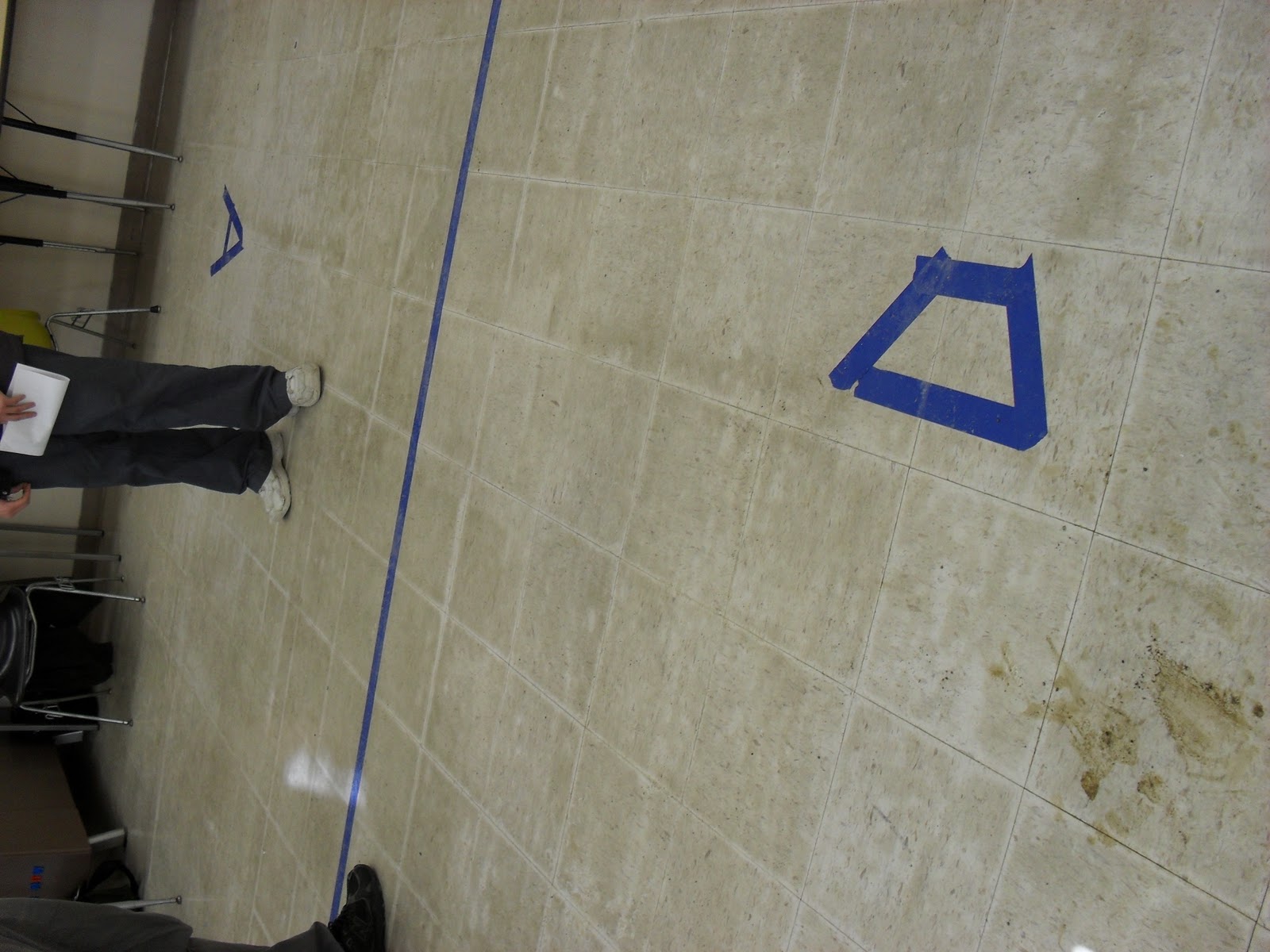
On Thursday we started a new unit, and we kicked it off by completing an anticipation guide for The Hunger Games by Suzanne Collins. We split the classroom down the middle (see pictures) and got into two groups: one for those who agreed and one for those who disagreed with the worksheet's statements.
Your individual arguments led to some really intense debate! We covered a lot of tough issues involving the importance of human life, family responsibilities, and social obligations. Thank you all for being so focused and honest with your answers, and for contributing to the discussion.
It was a pleasure to hear all of your beliefs and ideas, and I was impressed to see how well you stated your positions and listened to the arguments of other students. Well done!
Now that we've become familiar with the moral and social issues that are going to come up in The Hunger Games, my hope is that we'll be prepared for even more discussions like these. On Monday, we'll get acquainted with our new book and dive in! See you then!
Subscribe to:
Comments (Atom)